Fly of the Month
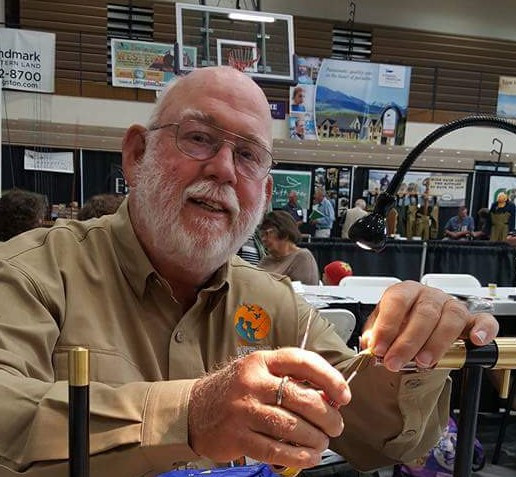
A Little About Dave Londeree
I was introduced to fly fishing at a fairly early age by my dad and by my Scoutmaster, Mr. E.G. Freeman. We lived in San Francisco, so it was always an adventure to go camping, hunting, and fishing. I still have my dad’s bamboo rod (hanging on the wall), and I have fished it from time to time. We almost always used “store-bought” flies. Mr. Freeman did teach us to tie a few flies, and they did catch fish. About the age of 12 or 13, I got my first fly tying vise from Herter’s catalog and used a few scraps of deer hair and thread from my mother’s sewing kit. I tied my first flies, somewhat crude, but as I was told, “ugly flies catch fish too.” They did, but seemed to come apart after a fish or two. Later, I was able to afford more and better material, and the flies got a little better. Then came a full-time job, a wife, and children. Fly fishing stopped for a very long time.
In 1980, I was transferred to North Idaho and was able to start fly fishing again. I was visiting one of our local fly shops and was told about the North Idaho Fly Casters club in Coeur d’Alene. There I met some really great folks and was reintroduced to the sport I enjoyed in my youth. I took a Beginning Fly Tying class from Mr. Erik Schubert, the club’s tutor, and really learned a lot. He was able to undo many of my bad habits. Jim Rogers and Bob Gary, to name a few, are good to watch and learn from.
The Fly Fishers International has been a great help to me. By watching some of the “Masters” at work, you really learn the techniques and tricks to tying some really great flies. At the FFI’s Fly Fishing Fair, there are some world-class fly tyers that are always ready to show you how to tie some of the most beautiful flies.
If you are just getting into flies, take some lessons, and tie, tie, tie. You will get better. In this age of the internet, there are thousands of videos you can watch with step-by-step directions. The FFI’s Learning Center has some of the best. Go ahead and tie a fly. Tie it on and cast it out. You won’t know how good it feels to catch a fish with a fly that you tied until you do.
— Dave Londeree
-
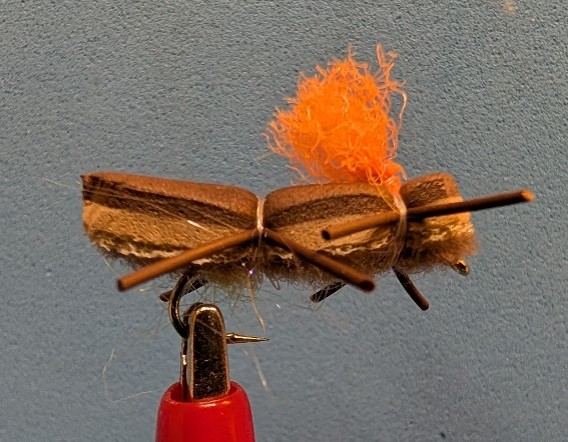
Freddy
- HOOK: #10 3X Long 1X Strong
- UNDERBODY: Ice Dubbing UV
- THREAD: Tan 6/0
- BODY: Top: Brown Foam, Middle: Tan foam Bottom: Tan Furry Foam
- LEGS: Round Rubber
- POST: Para Post Wig (Orange)
Tying Steps
- Cut the Brown and Tan 2mm Craft Foam to fit the Furry Foam. Using spray adhesive on both the brown and tan. Let the adhesive dry then stick them together. The furry foam needs to be pulled apart. Then spray adhesive the Tan Foam and the back side of the furry foam. Be careful placing them together, once they touch, they are stuck.
- Cut the body shape with a punch if you have one. If you don’t have a punch, cut the shape with scissors rounding the tail end.
- Pinch the hook barb flat and mount the hook in your vise.
- Dress the hook with thread from the eye to the hook bend.
- Make a dubbing noodle and wrap the hook shank from the eye to the bend.
- Add a drop of super glue right at the bend. Place the foam body on the hook shank so the tail hangs over about a hook gap behind the hook. While holding the body in place take 5 or 6 wraps of thread to bind the body to the hook.
- Attach the rubber legs to both sides of the body. Lift the remaining body up and move your thread half way to the hook eye. Add another drop of super glue and hold the body to the shank. Tie the body to the hook with 5 or 6 wraps of thread.
- Tie on another set of rubber legs. Double the Para Post material and tie it to the top of the fly. Move the thread to the hook eye and whip finish.
Note:
Thank you to Leeanna Young for showing us the Freddy at April club meeting. The Freddy is a high floater and can support a heavy dropper.